Compass
December 2021 Edition
Season 5 Episode 15 | 26m 46sVideo has Closed Captions
A caregiver event, Hmong New Year and esports at SMSU.
The December edition of Compass features a recap of Pioneer PBS’s Care for Caregivers event, the Hmong New Year celebration in Tracy and the esports team at Southwest Minnesota State University.
Problems playing video? | Closed Captioning Feedback
Problems playing video? | Closed Captioning Feedback
Compass is a local public television program presented by Pioneer PBS
Compass
December 2021 Edition
Season 5 Episode 15 | 26m 46sVideo has Closed Captions
The December edition of Compass features a recap of Pioneer PBS’s Care for Caregivers event, the Hmong New Year celebration in Tracy and the esports team at Southwest Minnesota State University.
Problems playing video? | Closed Captioning Feedback
How to Watch Compass
Compass is available to stream on pbs.org and the free PBS App, available on iPhone, Apple TV, Android TV, Android smartphones, Amazon Fire TV, Amazon Fire Tablet, Roku, Samsung Smart TV, and Vizio.
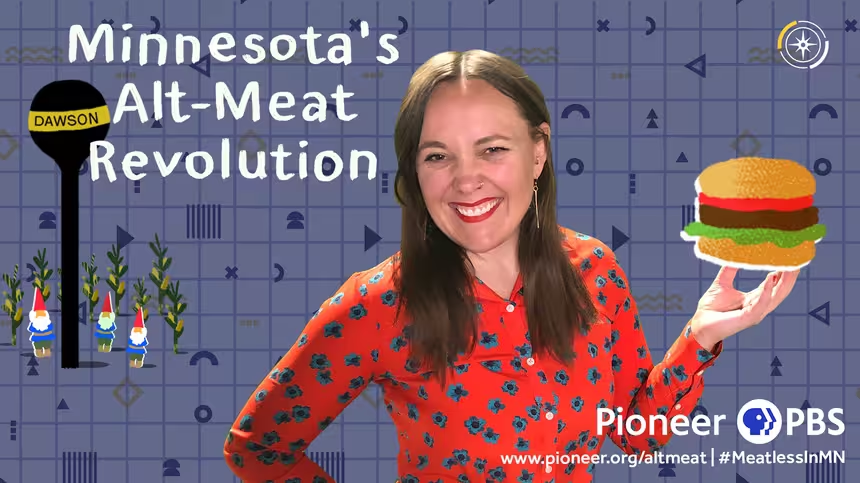
Minnesota’s Alt-Meat Revolution
“Minnesota’s Alt-Meat Revolution" is a year-long video and print journalism collaboration project, looking into the roots and impact of the plant-protein phenomenon that’s exploding across the globe.Providing Support for PBS.org
Learn Moreabout PBS online sponsorship(logo chimes) - Funding for Compass is provided in part by the Otto Bremer Trust, the McKnight Foundation and members of Pioneer PBS, thank you.
Hi, I'm Amanda Anderson, welcome to the December edition of Compass, the regional public affairs show on Pioneer PBS.
On tonight's episode, we'll hear from the esports team at Southwest Minnesota State University, and take a trip to Hmong New Year celebration in Tracy.
But a reminder, if you miss a story or want to rewatch, all of our stories are made available on our social media and website.
First, caregiving touches many people's lives and many people who are caregivers don't realize they are.
A special event at Pioneer PBS brought together people who work in the caregiver space to try to provide information and resources.
- Hi everybody, I'm Cathy Wurzer.
If you're not a caregiver now, odds are good that someday in the near future, you will be.
- [Amanda] On October 13th, Pioneer PBS hosted a screening event and discussion, promoting healthy conversations about caregiving, aging and dying and challenges facing rural caregivers.
The event was hosted in partnership with a number of organizations working to help people age well, including Prairie Five Community Action council.
- This event was a wonderful opportunity to come and see a screening of a film that really opened a lot of eyes to what it looks like to be a caregiver and caregiving in the home.
- [Amanda] The event included a screening of a documentary called "Caregiver: A Love Story" by Dr. Jessica Zitter, a palliative care physician who joined the conversation remotely.
A few people gathered at Pioneer PBS's studio, but most joined online.
Jason Swanson was in attendance in the studio.
- I'm Executive Director of the Minnesota River Area Agency on Aging.
And we provide resources and education and raise awareness on topics for older adults and caregivers.
So when you look at what a caregiver is, out here is gonna be normally a family caregiver.
And in rural areas, they don't live with their parent or with a loved one.
Usually there's a travel distance and that travel distance, according to recent study out for rural America, shows that they'll travel anywhere from 30 to 60 minutes, one way.
- Dr. Zitter, what do you think of what we've just heard here?
- Oh, I think it's really important.
And I think one other thing to add to that is there's been The National Alliance on Caregiving 2020 report, just talked about how much family caregivers on average spend of their own money on caregiving in the course of a year, and that's $6,000 of their own money.
And by the way, a third of family caregivers are making less than $50,000 a year.
So they're paying $6,000 on average of their own money, and that is twice as much if you live away from the care recipient.
- And then, also when you have a caregiver in the family, a family caregiver, the person you turn to is the one that's already in the profession, a nurse, a CNA.
So after their job, you know, they're... Whatever shift they're done with, the nocturnal shift, they'll go home and take care of mom, dad, or other loved one as well.
- Now let's meet a caregiver who fills this profile.
Okay, hi mom.
(chuckles) - Hi, Amanda, how are you?
- [Amanda] My mom is also a part of my grandmother's caregiving network, which includes my mom's siblings and their kids, along with hospice healthcare workers.
- My name is Carol Anderson and I retired two and a half years ago.
I worked at Allina Abbott Northwestern Hospital in the cardiovascular ICU.
Well, I'm a care... What would I call it?
Support caregiver.
So, my mom is 89 years old and I live in Minneapolis and she lives in Alexandria, which is about 120 miles from here.
- [Amanda] She'll drive about once a week to see grandma.
Because she'd worked in cardiovascular nursing for over 40 years, my mom tries to go to most of grandma's doctor appointments.
And while she said she doesn't think that her caregiving contributions are more significant than any others, she does think that her unique professional background gives her leverage here.
- [Carol] And so yes, answer to your question.
I think it would be harder if I didn't have the medical background that I do.
- [Amanda] I brought my mother into this conversation to show how close this issue is to many people.
And it's lucky really that my retired mom has both the medical background and now the time to be able to direct her expertise in this way.
- Well, I think the hardest part, especially for... Is understanding the medical system and just the different physicians that get involved.
You know, as people get older, they get cardiologists, they get different specialists and then it becomes really hard to coordinate all of that.
And that's what I was able to do because I understood that part of what happens.
- [Amanda] A reoccurring theme by many attendees at the Care for Caregiver event was how to have healthy conversations about end of life care.
And one organization facilitating these conversations is The Remember Project.
Danette McCarthy, the founder of The Remember Project was also in attendance at the event.
- So in my field of working with The Remember Project, we use theater as a tool to invite a conversation.
And it's exciting to me because most of us would rather talk about those people on the stage or those people in the film than we would like to talk about our own stories.
So it's really exciting to see that, and maybe this has been increased or exacerbated because of the pandemic.
We humans are social, we want to talk with each other, even about scary things.
And so it's very exciting to see that films, videos, theatrical productions can be so powerful in building that bridge and opening a heart toward a conversation.
I think our communities are ready.
- I'm not gonna say I'm not scared.
Who doesn't wanna just go to sleep and not wake up, you know?
Hopefully-- - [Amanda] Topics around death, dying and aging are heavy.
They're messy and hard to talk about.
But what if we, as a society, started thinking about aging as a privilege?
Not all of us get to age and age well.
Maybe this will help us start thinking about aging, death and dying as things to plan and celebrate, rather than a conversation to have later.
- This is a journey for the end of her life, and I wanna give her the best care I can give her.
(somber music) It's all about love.
(somber music) - Visit pioneer.org/caregiver/resources for more information.
Minnesota has one of the largest Hmong populations in the United States.
In November, the Hmong community in Southwest Minnesota celebrated Hmong New Year, along with a significant community milestone.
On November 20th, the Hmong community in Southwest Minnesota hosted a Hmong New Year celebration in the Tracy High School gym.
Khou Lor is the President of the Southwest Minnesota Hmong community called Southwest Minnesota Hmong Txu.
- Every community kinda has their own pers... You know head person, typically it's always been elders.
So it's just a really big change to have a young lady.
- [Amanda] She's in charge of planning- - Everything (laughs) - [Amanda] All of the things?
- Yes, organize everything.
It's more of like a celebration, you know really, like, honing in our roots and you know, what makes us Hmong people.
And it is to celebrate...
Traditionally it's celebrated during, or following a harvest for the year.
So back in the old country, it'd be, you know, anytime that they finished harvesting the rice patties and then they would have a new year for every like village.
- [Amanda] Hmong new year is celebrated anywhere between October and the end of the year.
Traditionally it varied from village to village and likewise in Southwest Minnesota, there isn't a set date from year to year.
- Before New Year, we didn't call it the new year at all, we called it, (speak foreign language).
Which means, it's time for a new beginning.
- [Amanda] Xiong Yang, he goes by Sean, was chosen to preside over the ribbon cutting ceremony.
Usually that's done by an elder, but with COVID-19, many community elders didn't attend the event.
(speaking foreign language) - [Amanda] The recital language is passed down from generation to generation.
Yang said that he felt a little nervous, he wanted to stay true to the linguistic tradition while making sure younger generations also understood.
- The language has been lost a little bit in translation.
So I have only been spoken about 50% of it.
So the elders speaks about 90% of it when we bless it, but when you use the actual language to recite it, a lot of the younger folks don't know it because it's just so deep and I tend to keep it on a little modern a little bit so that the younger folks will understand what's going on.
(speaking foreign language) So the whole ordeal of cutting the ribbon is to remove spirits and remove bad spirits.
Remove omens that's happened and going to happen.
(speaking foreign language) The first one is to eliminate all bad things.
(crowd applauding) And the second one is to bless everyone.
The balloon, before we used a... Take a gallbladder of a pig or a cow, but right now we use the balloon the significant the balloon is to... Because we have some or all of the spirits, are bad spirits, onto that balloon.
We take it outside and release all of the bad omens or bad spirits.
And so after that, when we drink that, we drink all of the good blessings.
So it's to bless for either education or prosperity, wealth and wellbeing.
- [Amanda] And then it's a huge party.
(bright music) There's dancing, singing, food, and of course, ball tossing, a kind of icebreaker game, which is just played for fun now, because traditionally this day was used to help people meet a potential spouse, explain Marcey Xiong, who used to live in Tracy, but now lives in St. Paul.
- So it's when you find somebody, you love, and you ball toss with them and if one drops the ball, they might have to give you a piece of, you know, like, a necklace or something like that.
- [Amanda] This year, the community was also celebrating the 30th anniversary of the arrival of Hmong people in Southwest Minnesota.
Sioux Moua is part of one of the first families that moved to the area, they came in 1992.
Coming from Laos an agrarian country, Moua said that his parents felt driven to move to rural Minnesota, but it was different for Moua who was just in first grade.
- And to not have other people speak your language, it was tough at first.
It was...
I guess you can say it made you feel really homesick 'cause we went from having maybe eight, nine other Hmong kids with you in the classroom to pretty much having no one.
- [Amanda] But over the years, he's watched the demographics in Southwest Minnesota change.
- Just to see everything change, I guess that's what makes this place so unique.
We're just honored and we're just blessed to have called this home for 30 years and this place has been amazing and I love it here.
I've gone...
I mean, sometimes they see me and they're like, how do you like the cold so much?
And I'm like, this is home, so we're used to it, you know?
I'm Minnesota and this is home for us.
- [Amanda] Saibert Moua is Sioux Moua's father.
Although he wanted to move to rural Minnesota, he also faced his own form of isolation and separation.
When he came to the United States, he was married with kids and had to find work right away.
He worked at Schwan's for many years, but now works at a farm helping to raise cattle.
This meant he didn't have the opportunity to go to school and learn English.
I had the privilege of talking with him through a translator, Shoua Thao, a kind of second nephew of Moua's, who also grew up in Tracy.
(speaking foreign language) - Being in their old country, because he could speak, not just his native tongue, but he was able to speak the Laotian language, too.
And he was a self-reliant.
You know, being self-reliant, being able to just do things for yourself.
We take our ability to speak the language for granted, right?
- [Amanda] But the Mouas and other first Hmong families paved the way for others to move to the area.
And over time, the community has grown from 7 to 10 families 30 years ago to over 100 families today, Shoua Thao predicted.
Data collected by Minnesota Compass, a data analysis project led by Wilder Research found that the foreign born Hmong population in Minnesota in 1980 was 2,600.
By 2019, it had grown to 29,180, but many have been noticing a deceleration in population growth in recent years.
- Lot of young folks, they graduate, grow up and move on.
But a lot of folks here, we see that the population has been steady, has been flat line and that's a lot of older folks is heartbreaking to see, to have them think that the population is depleting.
- Shoua Thao is Sean Yang's mother.
Their family came to Southwest Minnesota in 2003.
I also spoke with her with translator Shoua Thao's help.
(speaking in foreign language) - She's afraid that it's gonna be 50:50.
Some of the youth don't care too much about the traditions and culture.
And some still do, but there is no way of, you know...
There is no written anything, any written rules to say, hey, this is what we do to hold onto our cultures.
So it's kinda depending on the youth.
- [Amanda] She said that events like Hmong New Year are how younger generations are staying connected to and learning about their culture and traditions.
And it is the younger generation, albeit maybe not the youngest generation, that's trying to keep tradition going.
Last year, Southwest Minnesota State University in Marshall started offering Esports as part of their athletics department, making it the 19th collegiate sport offered at SMSU.
It's not your standard sporting arena.
- [Male Player 1] I'm in position, tell me when you want it.
- [Amanda] And just down the hall, a hurried student might not know the competition taking place in room ST 266.
- [Multiple Players] Good job.
- [Amanda] This is the second year that Southwest Minnesota State University in Marshall has rostered an esports team, which has competitive and organized video gaming.
Spencer Louwagie is the team's coach.
- I'm Spencer Louwagie.
I peaked diamond four in League of Legends.
- [Amanda] There are nine ranking levels in League of Legends and diamond is the sixth highest.
- So this is a League of Legends game that is going on in the background.
This is our... We only have one SMSU team for League of Legends.
It looks like we are currently winning, so that's good.
- [Amanda] I mean, if I'm talking to the esports coach, a game better be playing in the background.
Three years ago, Louwagie said that he attended an esports focused workshop at SMSU.
The school wanted to see if this was something they should be pursuing.
- So they asked the crowd, if anybody knew anything about esport still put things off.
And I was just the only one that raised my hand.
- You were like, hey.
- So yeah, exactly.
So they gave me the mic and I was doing an impromptu presentation on esports as a member of the IT team here at SMSU, I was going to be involved in helping figure out what they would need.
The current president has been very adamant about pushing for esports.
He has kids that are about that age that really got into esports.
- So I like a Rocket League to watch, Rocket League is the game where they play soccer in cars.
I have played Rocket League and I'm terrible at it.
So (chuckles) my children don't want to partner with me.
- [Amanda] No they don't.
(both chuckle) - Not really, but you know, they actually like to play with me, but you know, they can't win with me because I'm so terrible.
- [Amanda] Kumara Jayasuriya has been the president of SMSU since July 1st of 2019.
A fact sheet he provided, said that as of 2019, there were over 750 esports clubs on college campuses across the country.
Additionally, global esports revenues are expected to exceed $1 billion this year, according to Newzoo's 2021 Global Esports & Live Streaming Market Report.
President Jayasuriya said that SMSU is the first in the Minnesota state college and university system to have an esports team.
- There was no pushback.
One thing we wanted to make sure it is financially viable.
And we looked at it and said, if we can get so many students, we are okay to move forward.
- [Amanda] President Jayasuriya said the school paid $250,000 for the initial start.
And while he's been a champion for the esports team, he recognizes the balance required, when it comes to screen time.
- These students are going to play computer games, whether it's at the school or at home, they are going to play.
So we thought if we give them organized way to do this, it's better.
In fact, Spencer always tell them to take a break and, you know walk around and things like that.
When they play at home, they might not do that.
- [Amanda] The students said they make a point of going to the gym on campus to exercise regularly.
Esports offers opportunities beyond gaming, like computer science, marketing, social media and IT.
- It's a billion dollar business.
I'm sure business students will be interested in getting into that aspect of esports as well.
Another thing is esports from the beginning, had this cultural component to it because it's an international sport.
- And one of the cool parts about esports is we have such a diverse group of majors involved.
- So I was actually looking at SMSU first as a college option, for like biology program.
And then I did a tour here and I heard like the esports here.
And I was like, that's a really cool opportunity, 'cause I already gamed and there were multiple opportunities and the equipment here is so high tech.
- Kennedy Kucera from Watertown, South Dakota is on SMSU's valorant A squad.
- And I am currently platinum.
- [Amanda] Platinum is level five out of eight in the valorant and ranking system.
Kucera is also a commentator.
- Hello guys, welcome back to SMSU esport.
So I basically break it down, play by play, explain what's happening and talk about what should have happened or what they did well.
I actually really loved that round from SMSU they were playing back, they weren't pushing out into that smoke, trying to get greedy for a kill and it paid off.
They were able to make it out with three specters.
I would really actually love to do that, long-term especially being how few women are in gaming.
How that could actually be a possibility.
- [Amanda] She's the commentator for the valorant B squad.
The esports program, which is part of the athletics department has 41 students representing about 11 different games.
- We have our esports team, but really all those teams are broken down into separate teams within a team.
So we have esports as a whole, and then you have your League of Legends team, your Rocket League team, your Casco team, your valorant team.
And within that, we have team captains for each of those teams.
- I'm the beast man and my rank is diamond.
- [Amanda] Zaner Wysong is his real name He's from Hills, Minnesota, and is the captain of the valorant A squad?
Diamond is a level above platinum.
He said they practice two times a week, Tuesdays are more of a strategy day.
- Where Spencer and I actually run us through some strategies that he has.
And then Sunday practices is where we just play the A team and the B team we'll mix each other up and then just play a five on five game just to get more reps in.
- [Amanda] Wysong is also the IGL or in game leader.
- So I don't like tell people exactly what to do, but like, if we're like in a situation, I'll be the one to say, let's go this way.
Where do you want arrow going 'cause I got-- - [Male Player 2] I want arrow 4 for shutter.
- We're gonna draw a new hole, and we're gonna take you home KJ off.
And then we'll take the round.
I think a couple steps ahead like if this guys dead they're probably gonna do this.
And I think that's one quality, a good IGL should have been able to see, predict.
(indistinct chatter) - I think the game went really well.
We did end up having a sub for the game, 'cause one of our main players had somewhere to be.
- [Amanda] That's Kucera, she had choir practice this particular game night.
- Highlight of the game for me personally, it was probably just having everyone coordinate, even though we had a sub who we've never played with before.
So as the captain, that was nice to get everyone on the same page.
- [Amanda] The goal of president Jayasuriya is to have the esports team move games out of ST 266 and play on the basketball court.
But Louwagie admits that's a few years away.
For right now, he's happy with providing a space for more people to experience team sports on campus.
- I think it's a really important to give every student, you know, they're own opportunity to shine in college.
So this is just another way of allowing students who might not be able to shine a different way, a way to express themselves.
(players shouting) (indistinct chatter) - You can follow the SMSU esports team on Twitch and YouTube by searching for SMSU esports.
For the past year, I've been hosting Facebook Live conversations with area reporters about stories they're covering.
I recently spoke with Ryan Fayak a reporter for the Western Guard in Madison.
- I have far more fun writing about stories like I said, the mental health or the organization over in Canby with Angel Wings that reaches out to grieving parents and try to help them.
Say, hey, there's just talking and reach out if you need help and they'll share their phone numbers and say, call us or text us if you have a bad day, those are the ones that I like to write about the most.
So the veterans and those far more than meetings that get heated, which people love.
- Yeah, we try to employ something similar.
So we've been following this group called the Solutions Journalism Network.
Are you familiar with it?
- No, I've not heard of them.
- So it's finding solutions to challenges and in places and highlighting, it's not that you're not talking about the challenges or the bad, but you're highlighting the solutions, the things that people are doing to write or to work towards fixing those challenges.
And I can't...
I'm not one to like spew off any stats or anything because I can't remember exactly.
But there was studies that this organization had done that talked about how, especially right now, since there's so many external stressors that we have that to read about things that are solutions-based really help uplift community and they help uplift people and make them feel like they can contribute in a meaningful way rather than just feel like there's so much work that needs to be-- - Watch this full interview plus interviews with other area journalists at facebook.com/compass on pioneer.
Thank you for watching the December edition of compass.
We encourage audience interaction and feedback so head over to our social pages and website and interact with us.
And a heads up the January edition of compass will air on January 13th on Pioneer PBS.
See you then.
Funding for compass is provided in part by the Otto Bremmer Trust, the McKnight Foundation and members of Pioneer PBS, thank you.
(bright music)
Preview: S5 Ep15 | 30s | Watch the December 2021 Edition on Dec. 9 at 9 p.m. on Pioneer PBS or the PBS Video App! (30s)
Video has Closed Captions
Clip: S5 Ep15 | 8m 7s | Celebrate Hmong New Year in southwest Minnesota! (8m 7s)
Video has Closed Captions
Clip: S5 Ep15 | 8m 6s | Learn about SMSU's esports (competitive video gaming) team! (8m 6s)
Providing Support for PBS.org
Learn Moreabout PBS online sponsorship
- News and Public Affairs

Top journalists deliver compelling original analysis of the hour's headlines.

- News and Public Affairs

FRONTLINE is investigative journalism that questions, explains and changes our world.









Support for PBS provided by:
Compass is a local public television program presented by Pioneer PBS